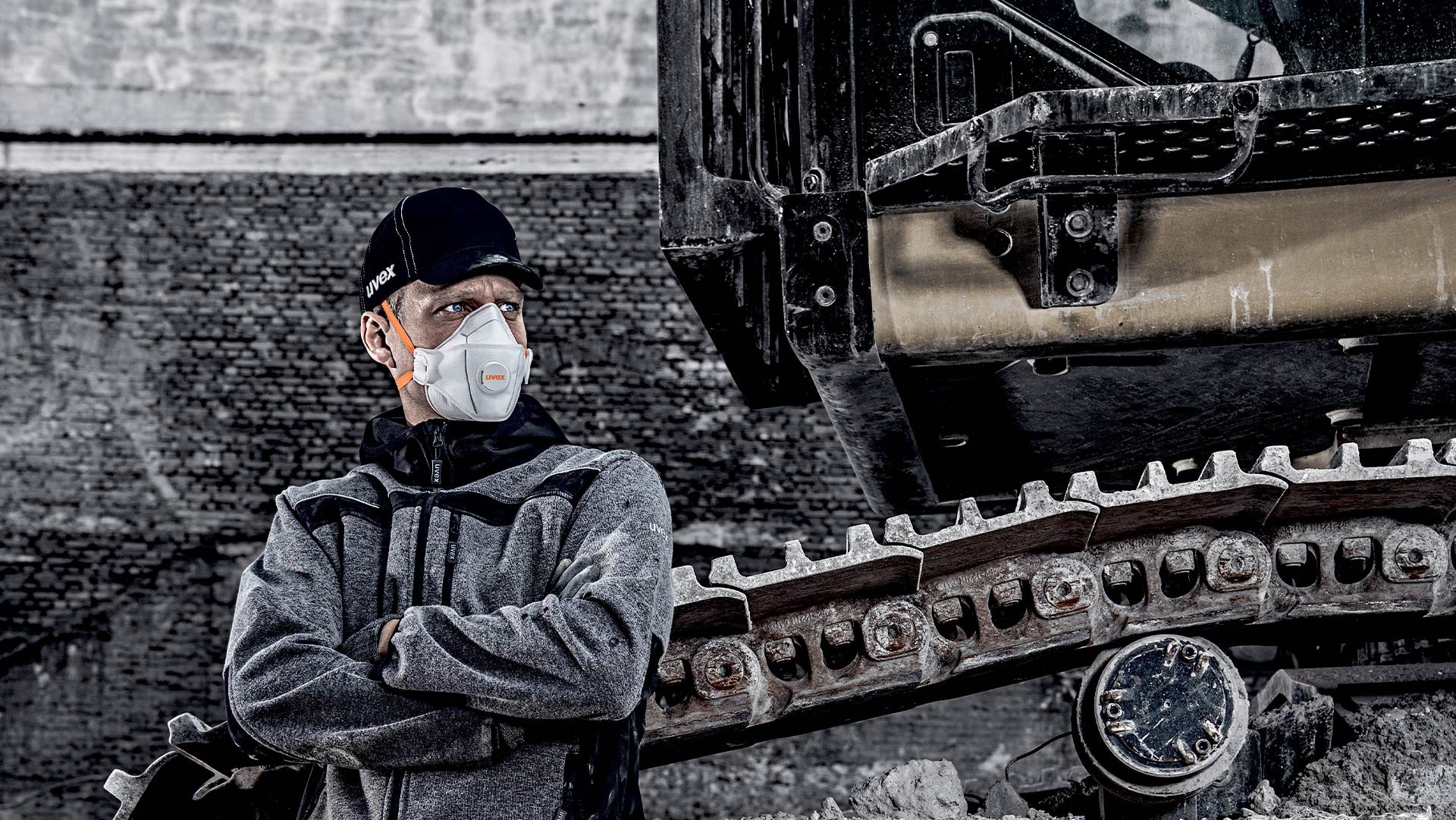
Key factors to consider before choosing a mask
Before selecting a mask model, several critical pieces of information must be known:

1. Identify the hazardous substance
Know the type, composition and concentration of the airborne contaminant (including CAS number and relevant OEL values).
2. Determine the required protection class
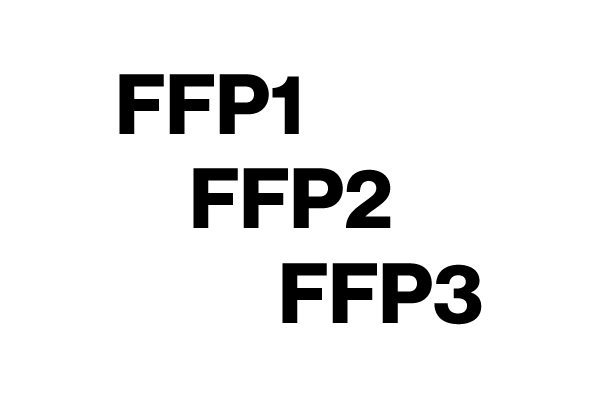
FFP respirators are categorised into three classes:
FFP1 – Filters at least 80% of particles
FFP2 – Filters at least 94% of particles
FFP3 – Filters at least 99% of particles

3. Consider work environment conditions
- Activity level
- Ambient temperature
- Duration of wear

4. Compatibility with other PPE
Respirators must work seamlessly with eyewear, helmets or hearing protection. uvex designs masks that pair optimally with uvex safety spectacles.

5. Check wearer suitability
Respirators will not fit properly on individuals with:
- Beards
- Thick sideburns
- Deep facial scars around sealing areas
Understanding mask markings and usage limits
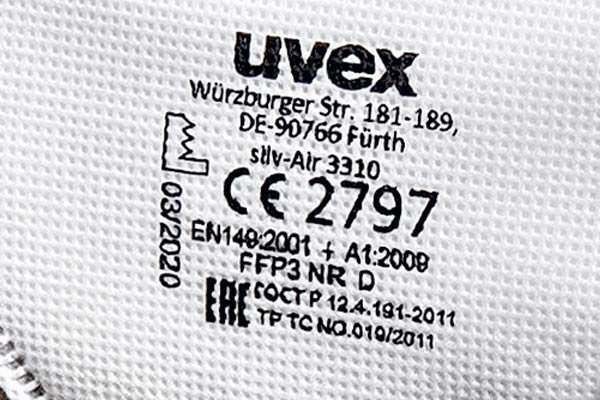
The required markings on a compliant mask include:
- Manufacturer Name/Trademark
- Standard Number & Year: DIN EN 149:2001 + A1:2009
- Product Classification: FFP1, FFP2, or FFP3
- Reusability Symbol:
- NR (Non-Reusable): suitable for a single shift (up to 8 hours)
- R (Reusable): may be reused for up to 24 hours but must be cleaned between uses
- D (Dolomite Clogging Test): Indicates the mask has passed the optional clogging test, meaning it maintains good breathability for longer, especially in high-dust environments.
- CE Mark: The mandatory CE symbol, often followed by a four-digit identification number of the notified body.
Replace any mask immediately if breathing resistance increases noticeably.
Selection based on working conditions
The uvex range includes options tailored to varying environments and task demands. Summaries below reflect typical recommendations:
Brief periods of use / lighter activities
| Protection class | Folding mask (without valve) | Cup-style mask (without valve) |
| FFP1 | 8763100 | 8762100 |
| FFP2 | 8763200, 8735200, 8735201 | 8762200 |
| FFP3 | - | - |
High‑intensity tasks / long wear times
| Protection class | Folding mask (with valve) | Cup-style mask (with valve) |
| FFP1 | 8763110 | - |
| FFP2 | 8763210, 8735210, 8735211 | 8762210 |
| FFP3 | 8735310, 8735311, 8763310 | 8762310, 8762312, 8762313 |
Protection against unpleasant odours (activated carbon layer)
| Protection class | Folding mask (with valve) | Cup-style mask (with valve) |
| FFP1 | - | - |
| FFP2 | - | 8762220 |
| FFP3 | 8735311 | - |
Which protection factor suits your needs?
Particle filters are divided into three classes
| FFP1 Respirators | FFP2 Respirators | FFP2 carbon layered Respirators | FFP3 Respirators | |
| Assigned Protection Factor (APF) | APF 4 | APF 10 | APF 10 | APF 20 |
| Typical applications | Low level fine dust/oil or water based mists (hand sanding, drilling and cutting) | Moderate level fine dust/oil or water based mists (plastering, cement, sanding and wood dust) | Options for metal fume, ozone and nuisance levels of certain gases and vapours | Higher level fine dust/oil or water based mists (hazardous pharmaceutical powders, biological agents and fibres) |
APF = Assigned Protection Factor
FFP1 Identified by blue valve lettering
FFP2 Identified by orange valve lettering
FFP3 Identified by grey valve lettering
When correctly used by a wearer who has passed a face fit test, an FFP1 respirator should reduce exposure to airborne particles by a factor of 4, an FFP2 by a factor of 10 and an FFP3 by a factor of 20.
How to fit a flatfold P2 mask
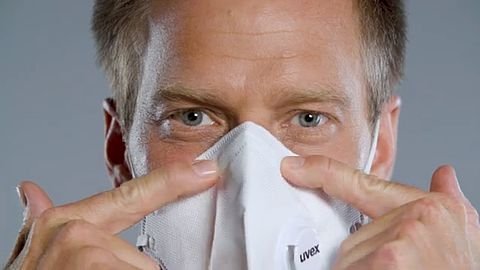
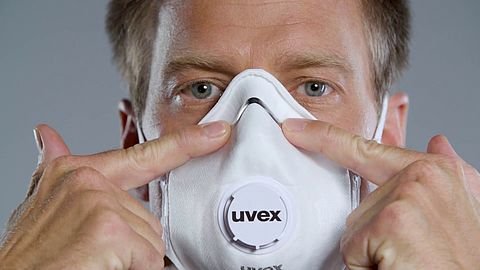
How to fit a preformed mask
FAQ's
Respirators (such as N95/FFP masks) are designed to seal tightly to the face and filter hazardous airborne particles, while standard face masks (e.g., surgical masks) are loose‑fitting and primarily provide barrier protection against larger droplets. Respirators undergo fit testing, provide a certified filtration performance, and must be worn correctly to achieve full protection.
In accordance with the EN 149 standard, an “R” certification for a disposable respirator stands for “reusable” and “NR” for “non-reusable.” In determining whether a mask can be used for a second shift, its cleanability is tested. If it is deemed cleanable, it is designated “R”, if not, it is marked “NR”.
Not everyone can safely or effectively wear a respirator. People with beards, heavy facial hair, or facial scars may be unable to achieve a proper seal, making the respirator ineffective. In addition, some medical conditions can make respirator use unsuitable, and a medical evaluation is required before fit testing in workplace settings.
Single-use respirators are designed to be worn for a single shift lasting up to eight hours. If your job involves handling toxic substances, the masks must only be used once, which means that every time the mask is taken off, it must be replaced with a new one (when working with viruses/bacteria or carcinogenic substances, for example). For hygiene reasons, single-use respirators must only be used for a maximum of one day and worn by only one person.
The additional filter containers significantly reduce the breathing resistance and work in conjunction with the inhalation valves to effectively regulate the temperature inside the mask.