
Why does mask size matter?
Air follows the path of least resistance. Any gap between the mask and your face means airborne particles can bypass the filter entirely. This means the mask cannot perform as intended, leaving you exposed. A well-sized mask will reduce this risk and help ensure the protection you expect.
However, achieving the right fit is not only about having the right size, but also about understanding how to get a secure fit on your face. Beards or stubble break the seal, allowing leaks to occur.
UK guidance on tight-fitting RPE recommends being clean-shaven where the mask touches the skin. Piercings, glasses, scars or prominent facial features may create gaps that compromise the seal or interfere with the mask’s position. These changes might seem minor but can significantly affect how well your mask protects you.
Without a proper seal, even the highest-grade filter cannot deliver the level of safety you expect. This is why professional face fit testing is so important, as it confirms that the mask works for you.
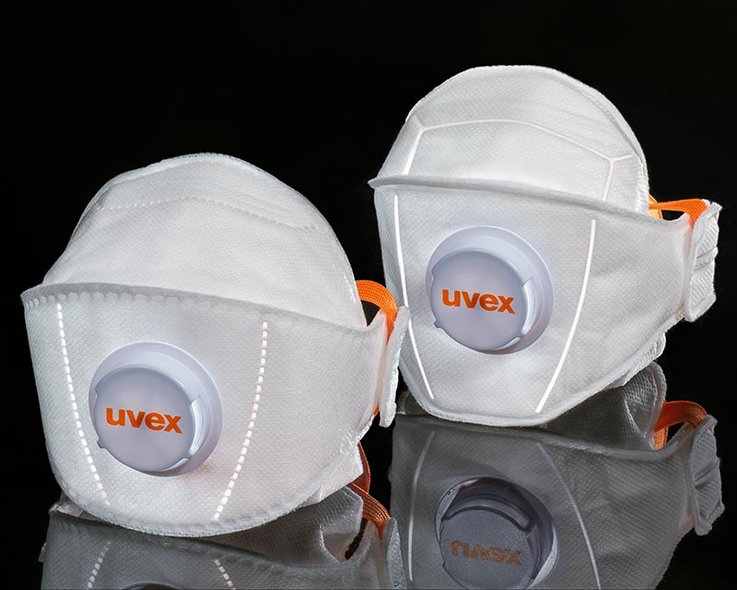
Mask fit testing
Fit testing of tight fitting respiratory protective equipment should be carried out by a competent person as part of the selection process. A mask may look secure when worn, but without a proper seal, it is less effective. Fit testing confirms whether the mask maintains a reliable seal during normal activities such as talking, turning the head, and bending movements that mimic real working conditions.
There are two common fit testing methods:
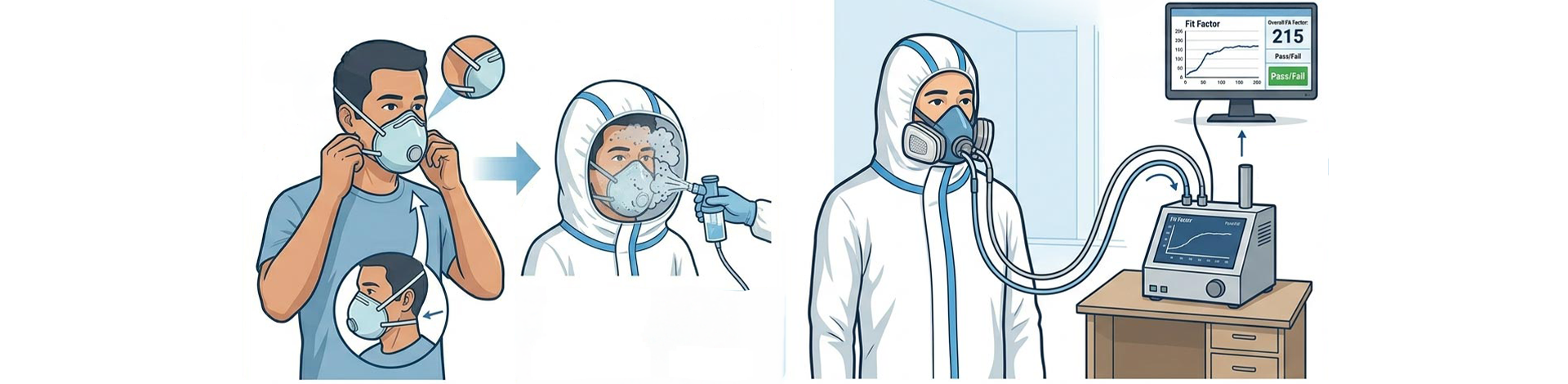
Qualitative Fit Test (QLFT)
This is a straightforward pass/fail test. You wear a hood over your mask, and a harmless substance such as Bittrex or saccharin is introduced inside the hood. If you can taste or smell it, the mask isn’t sealing properly, and the test fails. If you can’t, the mask passes.
Quantitative Fit Test (QNFT)
This uses a machine to measure how much air leaks into your mask. It compares particle levels inside and outside the mask and gives a score called a “fit factor.” For half masks, pass criteria depend on the type of tight fitting mask and applicable guidance.
Fit testing should be repeated if:
- Your facial features change
- You switch to a different mask model or size
- Company policy requires periodic checks
- Change any other part of your PPE that interacts with your face mask
- If risk assessments within the workplace change
uvex has various trusted and accredited BSIF Fit2Fit face fit testing partners across the UK. If you want to find out more or book a face fit test, then visit uvex-safety.co.uk/face-fit-testing.
Quick seal checks
Even after a successful fit test, it is important to check the seal every time you put on your mask. A user seal check is a quick, simple procedure that confirms the mask is seated correctly at the moment of use. There are two common methods.
- The negative pressure check involves covering the filter inlets and inhaling gently. If the mask collapses slightly and no air leaks in, the seal is intact.
- The positive pressure check requires covering the exhalation valve and exhaling gently. The mask should bulge slightly without air escaping around the edges. If you can feel your eye lashes flutter, the mask is not sealed correctly. These checks take only a few seconds but provide reassurance that the mask is working as intended.
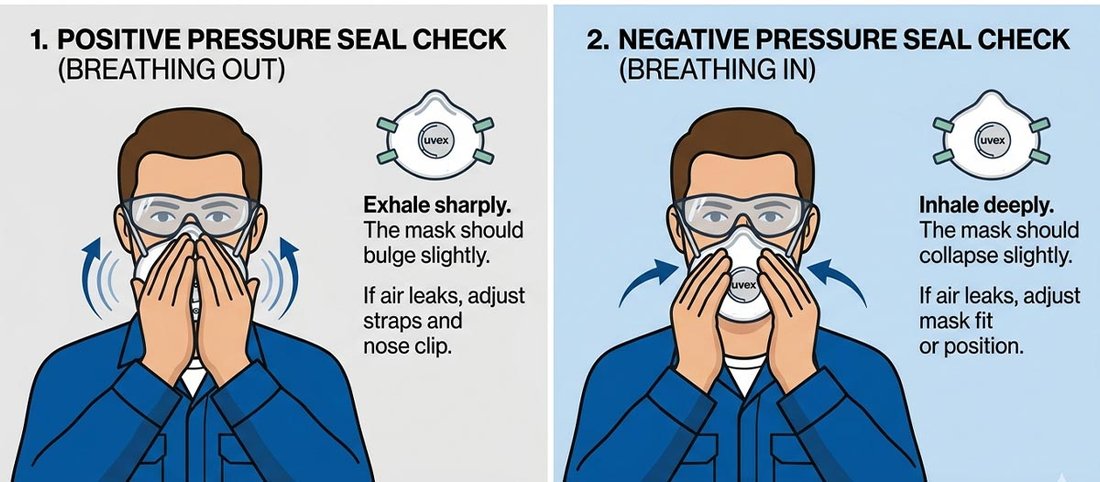
Seal checks are essential for daily use and user seal checks confirm correct positioning at the point of use, but they do not assess long term fit or suitability and cannot replace formal fit testing.
Looking for further guidance?
Choosing the right PPE can make all the difference when it comes to safety, comfort, and compliance. If you’d like tailored advice or want to trial uvex products in your environment, get in touch via our quick contact form or email marketing@uvex.co.uk.
FAQ's
How often should fit testing be done?
At initial selection and whenever facial changes or mask changes occur.
Do I need to be clean-shaven?
Yes, for tight-fitting masks. Facial hair prevents a proper seal.
How do I choose between FFP1, FFP2 and FFP3?
Match the class to the hazard and the level of protection required, based on risk assessment and guidance.
What if my face is small?
Choose smaller mask variants and confirm fit through testing.
Is a user seal check the same as a fit test?
No. Seal checks are quick daily checks; fit tests are formal assessments.