



Sustainability management and sustainability controlling
Sustainability is important, that much is certain. But how can sustainability be implemented in companies in the long term and how can you track progress or setbacks? For this purpose there are some approaches and principles that make sustainability measurable.
Corporate Social Responsibility (CSR)
Corporate Social Responsibility (CSR) is a basis of corporate social responsibility, or corporate social responsibility. This includes economic measures intended to contribute to sustainable development. CSR describes contributions that are voluntary and therefore go beyond the legal requirements for companies.
Global Reporting Initiative (GRI)
The non-profit foundation Global Reporting Initiative (GRI) was founded in 1997 and developed guidelines for sustainability reporting , which are internationally recognized as the reporting standard and, compared to other frameworks, are the most widely used in the world. The aim of the GRI standards is to establish reporting on the status of sustainability in the company. In addition, a sustainable global economy is to be built in which organizations act responsibly with the ecological, social and economic effects of their services and report openly about it.
Company reporting is judged on whether it is understandable, balanced, accurate, reliable, comparable and up-to-date . With the series of requirements GRI Universal Standards, GRI Industry Standards and GRI Topic Standards, the initiative supports companies in identifying relevant topics for sustainable development . Since July 2018, CSR reporting has also been based on the GRI standards.
You can find the uvex sustainability report according to GRI standards, which has been checked by the GRI service, here.

Sustainability strategies for companies
In order to further advance sustainability management and sustainability controlling, companies can use different principles as orientation. These help to find areas in which potential for sustainable action can be identified and thus support the definition of sustainability indicators and the implementation of specific goals.
In terms of sustainability potential , uvex has identified four areas in its company: ecological transformation, social responsibility, recycling management and pollutant management for materials that are harmless to health and the environment. You can read about the sustainability indicators uvex safety has defined for itself on our website.
Three Pillars of Sustainability
Sustainability Triangle
Different aspects of sustainability are often considered using the so-called "three-pillar model" or triangle. The pillars of sustainability stand for ecology, economy and social issues, these aspects are also known as the dimensions of sustainability. According to the model, sustainable development can only be successful if these three aspects interact and are worked on simultaneously and on an equal footing.
A supplement to these three pillars is the area of governance (corporate management): These criteria are firstly about the environment (environment) , i.e. good handling of resources, the climate, biodiversity and water resources, secondly about social (social issues). ) in relation to the safety and health of employees, demographic change and the food security of the population and thirdly to governance (company management) . This third area includes supervisory structures , the area of compliance and corruption as well as risk and reputation management. Governance therefore refers to sustainable corporate management , which is intended to ensure on a meta-level that the sustainability measures that have been decided on are implemented.
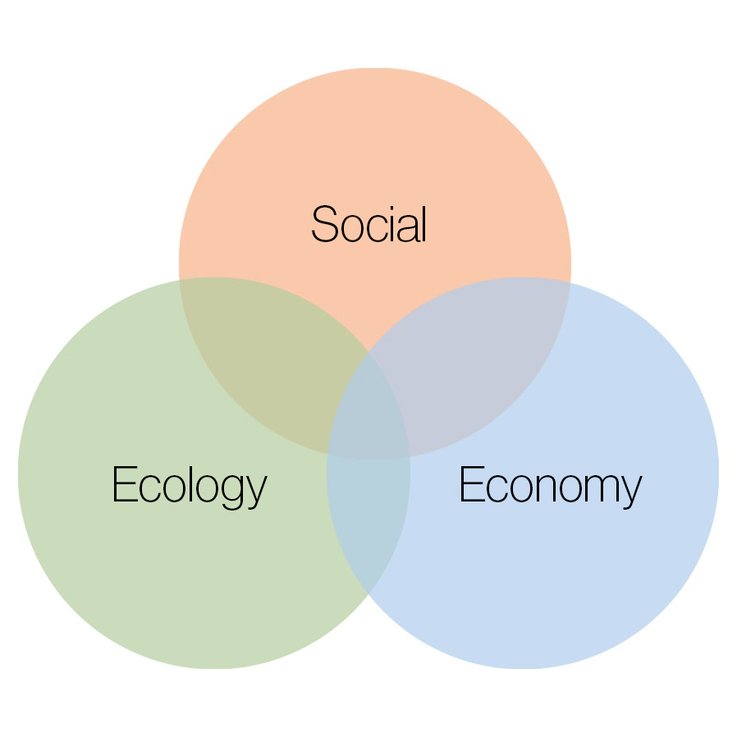

Ecological sustainability
This part of the three-pillar model addresses responsible use of the environment and natural resources such as water, energy and raw materials.

Economic sustainability
The economic pillar calls for sustainable management. This means that a company that operates as sustainably as possible must continue to generate profits. This is the only way to ensure fair payment, the use of high-quality raw materials and other sustainable developments.

Social sustainability
The social aspect of sustainability is about dealing with people and their working conditions. They should be guaranteed social justice, security, fair wages, constant further development and the free development of their own personality. Social interests also fall under this aspect.
17 sustainability goals (UN sustainability goals)
With the 2030 Agenda , the United Nations (UN) set 17 goals for sustainable development in 2016. These goals are to be aimed for in the 15 years between 2016 and 2030 and are based on the three-pillar model described above.
These goals serve companies more as a rough orientation framework for sustainability. Its core objective is to guarantee universal sustainable development – worldwide. The resulting social benefits help build a healthy life and prosperity for all people, which will have a long-term positive impact on the economy and thus companies.
| 17 goals of the United Nations | 1. No poverty | 2. Zero hunger | 3. Good health and well-being | 4. Quality education | 5. Gender equality |
| 6. Clean water and sanitation | 7. Affordable and clean energy | 8. Decent work and economic growth | 9. Industry, innovation and infrastructure | 10. Reduced inequalities | 11. Sustainable cities and communities |
| 12. Responsible consumption and production | 13. Climate action | 14. Preserve life below water | 15. Preserve life on land | 16. Peace, justice and strong institutions | 17. Partnerships for achieve the goals |
From these overarching goals, uvex has defined four target areas for sustainable, responsible behavior:

1. Strive for ecological transformation to achieve climate neutrality

2. Social responsibility for a positive change in society

3. Achieve circular economy for efficient use and recyclability of resources and durable products

4. Optimize pollutant management to protect public health and the environment
Sustainability guidelines and sustainability seal
If you as a company are actively committed to sustainability and regularly monitor your development, you would of course like to share your successes with employees and potential customers. That is why there are a large number of sustainability seals and sustainability guidelines for a wide variety of industries.
CSR and GRI: In Germany, the CSR and GRI measures described above are the standard for corporate sustainability reporting.
ISO-45001:2018: The ISO-45001:2018 standard specifies the requirements for occupational health and safety management systems , so it is in the service of occupational safety. It aims to promote the safety and health of employees by, for example, preventing accidents at work and sick leave as a result of work. Compliance with this standard can only be claimed by organizations whose occupational health and safety management system meets all the requirements.
ISO-26000:2010-11: The ISO-26000 : 2010-11 standard provides guidance on social responsibility and helps to integrate appropriate behavior into an organization's existing systems, processes, strategies , etc.